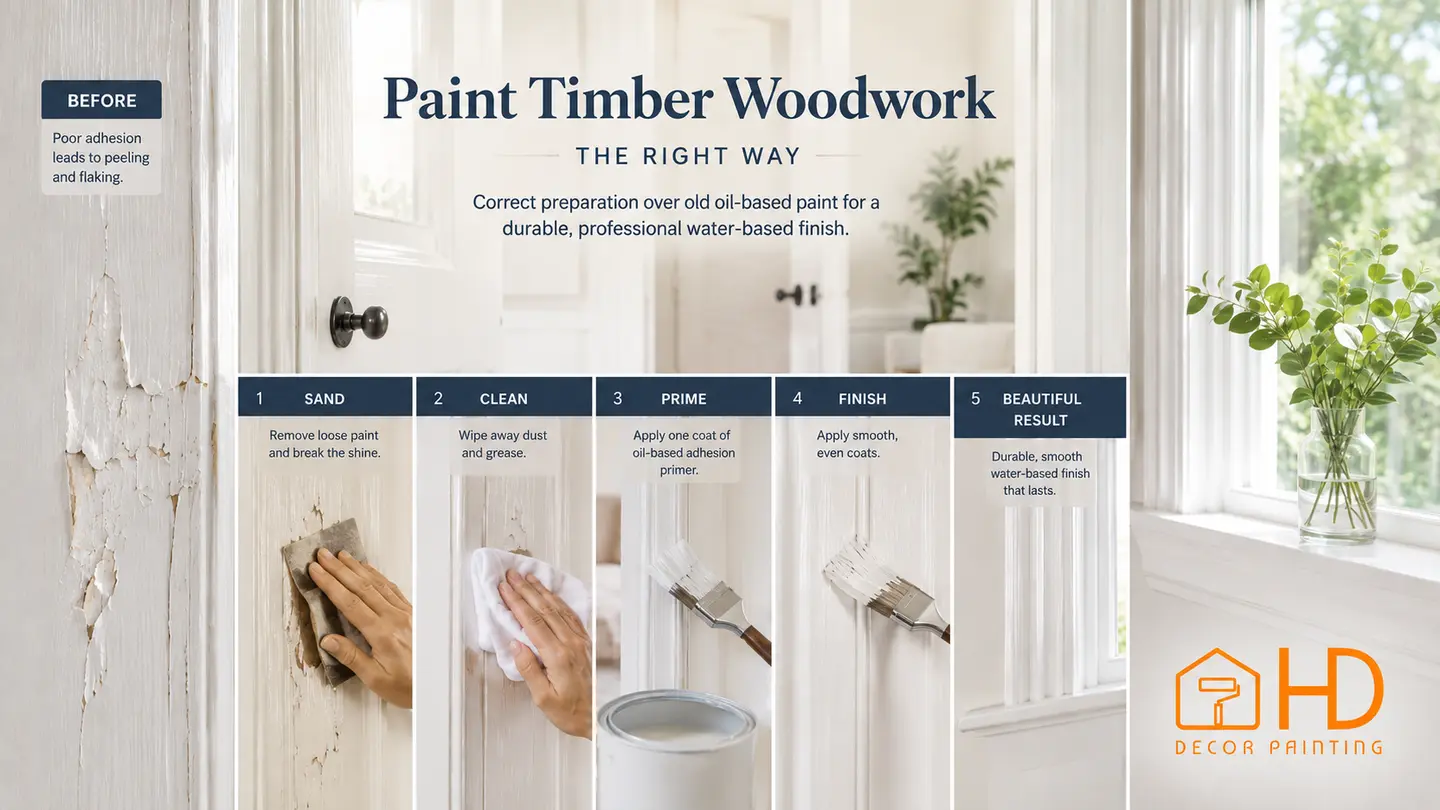
Painting timber woodwork such as doors, door frames, window frames, skirting boards and architraves might look straightforward. However, using the wrong preparation or paint system can quickly turn a simple painting job into an expensive repair.
One of the most common problems we find in older homes is water-based paint applied directly over old oil-based enamel without the correct preparation and primer.
At first, the finish may look perfectly fine. After some time, however, the new paint may begin to scratch easily, peel, flake or separate from the existing coating.
The problem is usually not the water-based finish coat itself. It is poor adhesion between the new coating and the old glossy oil-based surface.
The short answer: Yes, you can paint water-based paint over oil-based paint—but the old coating must be sound, thoroughly prepared and covered with a compatible adhesion primer first.
Why Does Water-Based Paint Peel Off Old Oil-Based Paint?
Traditional oil-based enamel was commonly used on timber doors, windows and trims because it created a hard, durable finish.
The challenge is that old enamel normally has a very smooth and glossy surface. If water-based acrylic enamel is applied directly over it, there may not be enough adhesion for the new coating to bond properly.
Simply cleaning the woodwork and applying two coats of new paint is often not enough. Proper preparation is essential.
Skipping these steps may save time during the original job, but if the paint begins peeling later, the surface may need to be scraped, sanded, primed and painted again, creating considerably more labour and cost.
How We Prepare Old Oil-Based Woodwork for Water-Based Paint
At HD Décor Painting, preparation is one of the most important parts of the painting process. When applying a water-based acrylic finish over an existing oil-based coating, our process generally includes the following steps.
1. Inspect the Existing Paint
Before painting, we check the existing coating for:
- Loose or peeling paint
- Cracks, chips and damaged areas
- Extremely glossy surfaces
- Grease, dirt or other contamination
- Signs of previous coating failure
Any loose or poorly adhered paint should be removed before proceeding. Painting over an already failing coating will not solve the problem underneath.
2. Sand the Existing Surface
It is not always necessary to remove all the existing oil-based paint if it is still properly bonded to the timber. Instead, the goal is to remove loose material and break the glossy surface.
Sanding creates a slightly roughened surface that gives the next coating something to mechanically bond to. Special attention should be given to edges, corners and areas around handles, where contamination and wear are common.
After sanding, the surface should have an even, dull appearance rather than remaining shiny.
3. Remove All Sanding Dust
Once sanding is complete, all dust needs to be thoroughly removed. Leaving dust behind can reduce adhesion and affect the final appearance.
The surface can first be vacuumed or brushed down, then wiped clean.
4. Clean and Degrease the Surface
After removing the dust, the surface needs to be clean and free from contaminants.
Where suitable for the existing coating, we commonly clean prepared timber with a clean, lint-free cloth lightly dampened with methylated spirits or isopropyl alcohol. The cloth should be damp rather than saturated.
Wipe the surface thoroughly and allow it to dry completely before applying primer. Always provide adequate ventilation, follow the product’s safety directions and keep solvents away from ignition sources.
What About Acetone?
Acetone can be an effective cleaner and degreaser in some situations, but it is a much stronger solvent. It can soften or damage certain existing coatings, plastics, fillers and surrounding materials.
For this reason, acetone should not be applied over the entire surface without checking compatibility first. If it is going to be used, test it on a small, inconspicuous area before proceeding.
The purpose of this cleaning stage is simple: remove grease, residue and contaminants without leaving anything behind that could interfere with primer adhesion.
5. Apply an Oil-Based Adhesion Primer
Once the surface has been properly sanded, cleaned and dried, we generally apply one coat of Zinsser Cover Stain Oil-Based Primer, depending on the substrate and existing coating.
This is one of our preferred primers for older enamel surfaces because it provides excellent adhesion and creates a reliable transition between the existing coating and the new water-based finish.
The primer also helps to:
- Improve adhesion of the finish coats
- Seal the existing surface
- Create a more uniform base
- Isolate certain stains and marks
- Reduce the risk of compatibility problems between coating systems
Using the correct primer is one of the most important parts of changing from an older oil-based enamel system to a modern water-based finish.
6. Lightly Sand the Primer if Required
Appearance is particularly important on doors, frames and windows. After the primer has dried, we may lightly sand the surface again to remove small imperfections, raised fibres or rough areas.
Dust is then removed again before the finish coats are applied. This additional preparation helps create a smoother and more professional final result.
7. Apply Two or More Finish Coats
Once preparation and priming are complete, the woodwork can be finished with the selected water-based acrylic enamel.
We normally apply a minimum of two finish coats, or additional coats where required to achieve the correct coverage and finish.
The result is a modern coating system with a smooth appearance that is properly bonded to the existing surface underneath.
The Common Mistake
The shortcut often looks like this:
Old oil-based enamel → quick clean → water-based paint
It may look good immediately after painting, but problems can appear later if the new coating has not properly bonded to the existing surface.
The better approach is:
Inspect → sand → remove dust → clean and degrease → apply adhesion primer → lightly sand if required → apply two or more acrylic finish coats
The preparation underneath the paint is just as important as the paint you can see.
How Can You Check the Existing Paint?
If you are unsure whether your doors or frames were previously painted with oil-based or water-based paint, simple coating tests can help identify the existing finish before work begins.
This is particularly important in older properties, where timber doors, windows, skirting boards and frames may have been repainted several times over the years.
When the previous coating is uncertain, careful preparation and a compatible primer become even more important. A professional painter can inspect the surface and recommend a suitable coating system.
Why Proper Preparation Saves Money
Preparation can sometimes take longer than the actual painting. That does not mean it should be skipped.
Repairing an incompatible coating that has started peeling can involve:
- Scraping away failed paint
- Additional machine and hand sanding
- Cleaning the entire surface again
- Re-priming
- Repainting
- Additional labour and materials
What could have been done properly once may need to be done twice.
Good preparation is not an unnecessary additional cost—it is what helps protect the painting work you are paying for.
Professional Woodwork Painting in Sydney
At HD Décor Painting, we provide professional painting and preparation for:
- Timber doors and door frames
- Window frames
- Skirting boards and architraves
- Staircases and balustrades
- Interior and exterior timber
- Previously painted oil-based woodwork
Every surface is different, so the preparation and coating system should always be selected according to the condition of the existing paint and the substrate underneath.
If your doors, frames or windows are peeling, cracking, yellowing or simply need a fresh modern finish, proper preparation can make the difference between a coating that fails and one that lasts.
Need Advice or a Quote?
Contact HD Décor Painting to discuss the condition of your doors, windows or timber woodwork and the most suitable painting system for your Sydney property.
- Phone: 0450 504 182
- Email: enquiries@hddecorpainting.com.au
- Online: Request a free quote